Book: China’s new place in a world in crisis

Summary: The world and China’s place in it have been transformed over the past year. The pressures for change have come from the most severe global financial crisis ever. The crisis has accelerated China’s emergence as a great power. But China and its global partners have yet to think or work through the consequences of its new position for the governance of world affairs. China’s New Place in a World in Crisis discusses and provides in-depth analysis of the following questions. How have China’s growth prospects been affected by the global crisis? How will the crisis and China’s response to it impact China’s major domestic issues, such as industrialisation, urbanisation and the reform of the state-owned sector of the economy? How will the crisis and the international community’s response to it affect the rapidly emerging new international order? What will be China’s, and other major developing countries’, new role? Can China and the world find a way of breaking the nexus between economic growth and environmental sustainability — especially on the issue of climate change? Download 486 pages PDF or view China Whole Book on Scribd


What is the Common? An International Conference

Gothenburg, Sweden: “The Kurrents‘” program for 2009 is organized under the title “What Is the Common?”. It is again a co-organized event together with invited artists, researchers and internationally leading intellectuals. The intention is to investigate different axes related to the common as both a real force and an idea. As such the common permeates such diversified domains as artistic practice, law, economy and gender relations.
From the Call for Papers:

In the shadow of the global crisis of capitalism, the common, somehow obliterated in the recent past, has emerged as an indispensable and central notion. The conference addresses this notion both as a real movement and as an already present horizon, a dynamic principle, for societal life. It is a critical topic today, not only because the public, administrated by the state, is reduced to expendable assets for regulating a supposedly self-regulating machine called Market, but more importantly because the emerging forms of the common impose themselves with an unprecedented acuity and in opposition to the doxa of the private property.

Read more

Neoliberalism in the oceans: ‘‘rationalization,’’ property rights,

Neoliberalism, with its emphasis on privatization and marketization, is becoming a dominant mode of ocean governance. In this paper I show that neoliberalism in ocean fisheries has a specific form and history based on the ways that, for the last 50 years, regulation debates have centered on the question of the commons. Focus on the role of the commons in problems such as overfishing and overcapacity has contributed to convergence of different viewpoints around neoliberal, market-oriented approaches that try to harness the profit motive to conservation and economic efficiency. I trace the idea of property rights in fisheries from the point in the 1950s when economists first identified the commons as the underlying cause of fisheries problems, through extended political jurisdiction, to recent emphasis on the benefits of common property. Despite their differences, proponents of these different viewpoints all take property as their central problematic and contribute to the idea that creating market incentives, by specifying property rights, is the foundation upon which proper use of ocean resources rests. I illustrate these ideas with a description of the shift toward privatization in the fisheries of the US portion of the North Pacific, which have a direct annual value of almost $1 billion. Neoliberal approaches to fisheries regulation are not simply spillover from larger trends toward market-based governance, but instead are influenced by the ways that past policy orientations toward fisheries have centered on enclosing the oceans within carefully delimited regimes of property rights, be those regimes of collective, state, or private control. Download the article as PDF

PIQUE final report out now.

The PIQUE project (Privatisation of Public Services and the Impact on Quality, Employment and Productivity) investigated the impact of liberalisation and privatisation of public services on the quality or work and employment, productivity as well as the quality of public service provision. The Summary Report brings together the key findings of the project, including the results of an investigation of the processes of liberalisation and privatisation and the forms of regulation in the four sectors and six countries investigated; an analysis of company reactions based on a series of case studies; the impact of privatisation and liberalisation processes on labour relations, employment and productivity; the results of a representative survey on users’ perceptions, as well as overall conclusions and policy recommendations.

NGO warns against biopiracy of climate-resilient crops

Navdanya, a non-governmental organisation (NGO) in India, has sought government intervention to stop biopiracy of climate-resilient crops by global gene giants who are reported to have applied for patents on farmers’ innovation of seeds that are resistant to drought, floods and salinity. By attempting to patent farmers’ innovations, the multi-national gene companies are not only out to make profits but also want to position themselves as saviours of the world against climate change said Vandana Shiva, the founder of Navdanya.

Bailout-Economy: Privatizing Gains And Socializing Losses

There is no shortage of opposition to Treasury Secretary Timothy Geithner’s new bank bailout plan, and while some arguments are unfounded, Joseph Stiglitz does make a good point. According to Stiglitz the worst part about the bailout plan is that it will privatize gains while socializing losses. With this in mind it makes it an overall losing proposition for taxpayers. In addition to this argument Stiglitz makes several others against the bailout plan in his article as presented by Mark Thoma.

Symposium for a social railway

Auf zur Europäischen Konferenz BürgerbahnSymposium on a social railway on Saturday, 16/05/2009 with opening events on the evening of Friday, 15/05/2009 in Düsseldorf and Cologne. Organised by the German coalition against railway privatisation “Bahn für Alle”, the German Green Party (North Rhine-Westphalia) and the National Union of Rail, Maritime and Transport Workers (RMT), Britain. See pdf-Flyer or read more

Protest Rallies Against Turkish Dam Continue

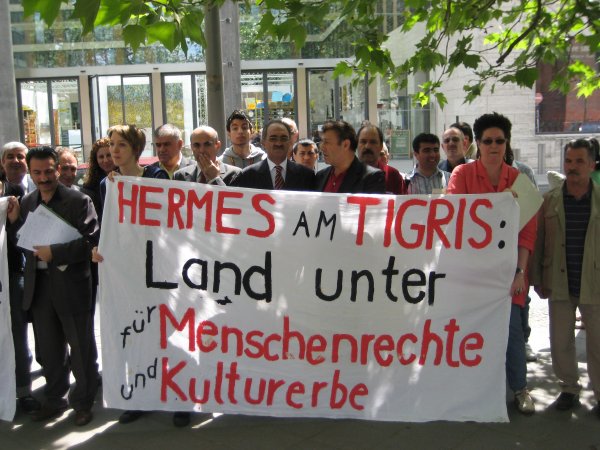
Proteste gegen die Hermeskredite für den StaudammCritics of the ill-conceived Ilisu Dam in Turkey today held protests and rallies all over Europe in front government buildings, banks and companies involved in the dam project. Actions were planned for Paris, Milan, Rome, Perugia, Berlin, Stuttgart and other German cities today, March 14, to mark the International Day of Action for Rivers, Water and Life. At least 77 organisations from 20 countries, including France, Germany and Italy, are all urging the governmental and financial institutions to withdraw from the project. Read more

Doug Henwood: Nationalize the Banks!

Doug Henwood delivered ”Nationalize the Banks! What Does it Really Mean?,” on a panel organized by the Socialist Register, at the Left Forum, New York City, April 19, 2009:

“The title of our session reminds me of that glorious week in Seattle back in December 1999. At that time, and for a little while afterwards, it seemed like a new movement had been born, and there was some real potential for transforming, or even overthrowing, capitalism. One of my favorite chants of that moment of carnival came from the unfairly maligned Black Bloc: “Capitalism? No thanks! We will burn your fucking banks!” Not constructive, perhaps, but inspiring nonetheless.”

Read more