Commons in turbulent times
 After several decades of relentless neoliberal enclosures, the idea of ‘commons’ is enjoying a renaissance amongst some neo-Keynesian economists and commentators, while political scientist Elinor Ostrom has just been award the Nobel prize ‘for her analysis of economic governance, especially the commons’. Massimo De Angelis explains why capital’s commons will always be distorted – because they are based upon social injustice – and why we can only reclaim the commons from capital by constructing common interests. Read more about the tragedy of the capitalist commons
If the cell form of capitalism is the commodity, the cellular form of a society beyond capital is the common. Nick Dyer-Witheford discusses the circulation of commons and the conditions they would create for new collective projects and waves of organising. Read more about Commonism
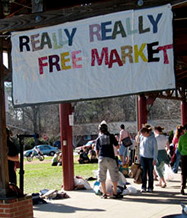 According to the capitalist lexicon, the “Free Market” is the economic system in which prices are determined by unrestricted competition between privately owned businesses. Any sensible person can recognize immediately that neither human beings nor resources are free in such a system; hence, a “Really Really Free Market” is a market that operates according to gift economics, in which nothing is for sale and the only rule is share and share alike. In the interest of not taxing the reader’s patience, a single apostrophe stands in for the two “Really”s throughout this text.
  There are no more conferences. The final product of the CA



 The »Creative Industries« are considered key to the city development in the 21st Century. Cities such as Berlin put them at the center of image and location policy. The debates are mainly of benefit to the economy and capital development at the forefront – the changed living and working conditions of creative people are in contrast scarcely taken into view. They will be the topic of the congress. The digital revolution in production and distribution, the struggles for intellectual property and realization rights, more flexible corporate structures and labour relations, the project form of work and the privatization of cultural institutions have changed jobs and lifestyles as subjectivities. An unwieldy number of opportunities face enormous competition for jobs and contracts, increased chances of expression the pressure of conformity by the market, more self-determination the self-exploitation in informal and precarious employment relationships and with unfettered income at the same time.