Really Really Free Markets

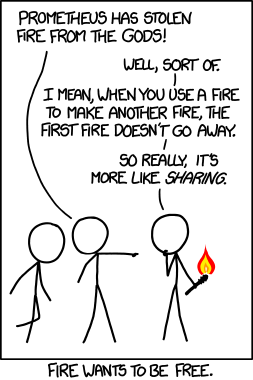
According to the capitalist lexicon, the “Free Market” is the economic system in which prices are determined by unrestricted competition between privately owned businesses. Any sensible person can recognize immediately that neither human beings nor resources are free in such a system; hence, a “Really Really Free Market” is a market that operates according to gift economics, in which nothing is for sale and the only rule is share and share alike. In the interest of not taxing the reader’s patience, a single apostrophe stands in for the two “Really”s throughout this text. Read more

Czech Republic: Law against commons

Markus Euskirchen | 2. September 2010 | Filed under: Education/Knowledge | Leave a comment

A leaked draft of the new Czech Copyright Act was obtained by Pirate News at the beginning of August 2010, after the Ministry of Culture has initially declined the request of Czech Pirate Party to have access to the document three days after the draft was sent out for feedback to organizations affected by the proposal. The draft presents a storm of “improvements” which grant millions of euro from public sector budgets to collecting societies. Read more

(Deutsch) Leerstand Hamburg

Markus Euskirchen | 31. August 2010 | Filed under: Practical Struggles | Leave a comment

Wikipedia Watch

Markus Euskirchen | 13. August 2010 | Filed under: ActorsCommunicationEducation/KnowledgePublic Goods | Leave a comment

The people behind google-critical Google search front end “Scroogle Scraper” also run Wikipedia-Watch. Stressing their weird humor they point out weaknesses and lapses of the wikipedia principle – and thereby maybe of the more general principle of commons based peer produktion.

Power Structure Research

Markus Euskirchen | 12. August 2010 | Filed under: ActorsDistribution of Wealth | Leave a comment

Power structure research is an approach to the study of power that highlights the unequal distribution of resources upon which power is based (e.g., wealth, political office, control of the mass media) and the importance of formal and informal social networks as the means by which power is concentrated and institutionalized. Read more

Once again pretending to save the world…

Markus Euskirchen | 4. August 2010 | Filed under: Biodiversity/gen.Ressources | Leave a comment

…by supposing to turn something into private property: Read the summary of the article “Resolving the Tragedy of the Commons by Creating Private Property Rights in Wildlife” to have another example for the the bullheadedness of the bourgeois mind:

During humanity’s relatively brief existence on this planet, it has relied on the bounty of its flora and fauna for his existence. For most of history, this exploitation had little impact on the earth’s resources. Only in recent centuries has man’s exploitation of wildlife begun to have a deleterious effect, even though there is increasing evidence that primitive societies had a profound impact on many species. Overexploitation of wildlife is not a peculiar characteristic of Western civilization, nor is it a consequence of commerce.

Read more

Consequences of commodification

Markus Euskirchen | 28. July 2010 | Filed under: ActorsEducation/Knowledge | Leave a comment

The Times newspaper’s website has lost two‑thirds of its audience following the implementation of a paywall, according to data published yesterday – a dramatic decline, but not as steep as many had forecast. Read more: Techdirt and Guardian

Right to Water at the UN

Ann St | 22. July 2010 | Filed under: General | Leave a comment

Nobody can survive without water, water is necessary for all life on earth. For the first time since the Universal Declaration of Human Rights was adopted 60 years ago, the UN General Assembly is finally poised to recognize the Human Right to Water and Sanitation. By the end of July 2010, the General Assembly will consider an historic resolution brought to the UN member states by the Bolivian government.

July 22 is an international day of action to protest against multinational corporations and pollution, calling for the human right to water and sanitation.

One and a half billion people across the world lack drinking water and another two billion lack clean water generally. In 20 years’ time these numbers will have doubled. Agricultural and industrial pollution is degrading the quality of fresh water supplies everywhere.
Billions of people are suffering because the world is not focused on providing water and sanitation for all. A strong UN General Assembly resolution will signal that water and sanitation is key priority for the international community. The date set for UN member states to consider the resolution is Wednesday, July 28th.

see also: http://www.blueplanetproject.net
http://www.ourwatercommons.org

Global Intellectual Property Right will cause more wealth on the one hand and death on the other

Markus Euskirchen | 13. July 2010 | Filed under: Health/Social Issues | Leave a comment

International experts claim ACTA („WTO Agreement on Trade Related Aspects of Intellectual Property Rights“) to threaten global access to affordable medicines. Read more

FIFA World Cup: gains and debt

Ann St | 8. July 2010 | Filed under: General | Leave a comment

What is left after the World Cup?

Video: Wavering Flag by Playing Fields Connective

The FIFA Soccer World Cup in South Africa – a critical parody. Soccer stadiums were built, not schools, gains are being made by a few, many are left with debt.

Crises of Capitalism

Ann St | 5. July 2010 | Filed under: Debates: Theories/AlternativesDistribution of WealthGeneral | Leave a comment

Harvey animation video

In a short animation video, radical sociologist David Harvey asks if it is time to look beyond capitalism, towards a new social order that would allow us to live within a system that could be responsible, just and humane. View his full lecture at the RSA (Royal Society for the encouragement of Arts, Manufactures and Commerce).

Re-envisioning the City

Ann St | | Filed under: GeneralPolitical AlternativesPractical Struggles | Leave a comment

You can’t imagine a more just, more sustainable planet, without also imagining a new kind of city. More than half of the world’s population is urban, and cities often amplify many of the problems we face as a planet: inequality, violence, pollution, isolation. Luckily, people around the world are joining forces to re-imagine how we design and live in cities, and they’ve come up with a number of exciting proposals!

Female care work seen as a “Common”

Markus Euskirchen | 28. June 2010 | Filed under: Debates: Theories/AlternativesHealth/Social IssuesPublic Goods | Leave a comment

Provoking: Female care work seen as a “Common”:

“The roots of sexism and racism are the same: a situation where you need workers without rights. Enslavement is essential to this process of accumulation and these have not been one time events; these developments became structural to capitalist society. In the last twenty years you can see similar developments. A globalisation based on land expropriation, migration, an increase in the impoverishment of women, mass prostitution, baby markets etc. As a result of present globalising drives, there has been an explosion of violence against women. Over the last fifteen years there has been a return to witch hunting, in Ghana for instance. The redefinition of the social position of women turns the woman into a kind of compensation for the man’s loss of power. The woman is a new common, seen as the new nature, like water etc, something everyone can go and get.” Silvia Federici, 2006

Read more

An Interview on the Commons with de Angelis and Stavrides

Ann St | 24. June 2010 | Filed under: General | Leave a comment

pingThe term “commons” occurs in a variety of historical contexts. First of all, the term came up in relation to land enclosures during pre- or early capitalism in England; second, in relation to the Italian autonomia movement of the 1960s; and third, today, in the context of file-sharing networks, but also increasingly in the alter-globalization movement. In a public interview, Massimo De Angelis and Stavros Stavrides explain their interest in the commons.

Article: Escaping the bondage of the dominant agrifood system: community-based cooperative strategies

Markus Euskirchen | 18. June 2010 | Filed under: Biodiversity/gen.RessourcesDistribution of Wealth | Leave a comment

agrifoodThe “Missouri School” of critical agrifood studies has provided an effective framework for documenting and understanding the structural dimensions of the global agrifood system and locating important nodes of power. This has directed attention toward the negative impacts of industrialization and corporate concentration on agricultural producers, local communities and economies, and the environment. Using these critical insights, pressure on the dominant agrifood system by civil society organizations has resulted in important changes to production and marketing strategies and related public policies. We broaden this discussion by using social movement and livelihoods theory to explore the position of limited resource and minority producers in the southern United States. This analysis helps us to identify spaces for local responses in community-based cooperatives and other organizations. Read more (pdf) or see Southern Rural Sociology 2009 TOC

Contesting property: “Steal something from work day” 15th of April

Markus Euskirchen | 10. June 2010 | Filed under: Practical Struggles | Leave a comment

stealfromworkDon’t carp, carpenters!
Don’t wait, waiters!
Let’s put the team in teamster!
Every steelworker a steal-from-worker!
Every hoodlum a Robin Hoodlum!
Raise the bar, baristas!
Raise hell, bellboys!
Wage war, wage slaves—
April 15 is Steal Something from Work Day!


Next page
  • Hot!

    Deutschsprachige Mailing-Liste abonnieren: Mail an rls-ppg-request@lists.rosaluxemburgstiftung.de mit dem Text
    »subscribe adress=emailadresse« im Betreff.
  • Publications

    Mario Candeias/Rainer Rilling/Katharina Weise: Krise der Privatisierung - Rückkehr des Öffentlichen WSI-Mitteilungen 10/2008

  • Kalender

    September 2010
    M T W T F S S
    « Aug    
     12345
    6789101112
    13141516171819
    20212223242526
    27282930  
  • ppg-Material

    Newsletter >>>
    Annual Meeting 09 >>>

    Annual Meeting 07 Audio >>>

    Annual Meeting 06 >>>

    Annual Meeting 05 Audio >>>

    Mailinglist
    >>>
    rss?
    Info-Flyer >>>

  • Archive

  • Featured Multimedia

  • Blogging for PPG:

    Lutz Brangsch * Mario Candeias * Markus Euskirchen * Andrej Holm * Stephan Lindner * Sabine Nuss * Rainer Rilling * Ann Stafford * Katharina Weise
  • Flickr Pix

    Eimsbütteler TV: Sportler für Privatisierung

    Berliner S-Bahn-Chaos

    raumgewinn

    Der ETV in der Agaplesion-Arena (2009)

    More Photos
  • Meta

  • Links

  • Most Visited


    Trend zur Rekommunalisierung: Vorwärts ...
    Publikationen
    Netzwerk
    De-Privatisierung in USA
    Privatisierungsfolge S-Bahn-Kollaps

  •     Visits last week: 1431

  • privatization