
Community Gardening and Grassroots Politics in the Neoliberal City
When community garden activists of the 1970s and early 1980s clandestinely planted tomatoes, cucumber and sunflowers in abandoned backyards and on run-down lots, they probably never imagined that a time would come when city administrations would embrace urban gardening as an important “cultural, ecological and social resource”.1 Many of today’s community gardens in North America and Europe started out as squats or informal “guerilla style” gardens and were influenced by, if not a substantial part of urban social and environmental movements of the 1960s and 1970s.2
Read more | ›››
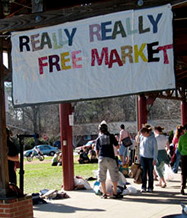 According to the capitalist lexicon, the “Free Market” is the economic system in which prices are determined by unrestricted competition between privately owned businesses. Any sensible person can recognize immediately that neither human beings nor resources are free in such a system; hence, a “Really Really Free Market” is a market that operates according to gift economics, in which nothing is for sale and the only rule is share and share alike. In the interest of not taxing the reader’s patience, a single apostrophe stands in for the two “Really”s throughout this text.